| Acidize |
When acid is used to remove mineral and iron
deposits (scale) to restore heat transfer efficiency. |
| Air Balance Test |
A test used to measure airflow across a tower
or air handler system. |
| Air Balancing Hood |
Measures airflow from grilles and diffusers. |
| Amp (Ampere) |
The practical meter-kilogram-second unit of
electric current that is equivalent to a flow of one coulomb
per second or to the steady current produced by one volt
applied across a resistance of one ohm. |
| Amp/Ohm/Volt Meter |
Measures motor amperage and voltage test
controls. |
| ARI |
Air Conditioning and Refrigeration Institute |
| Baseline Data |
Baseline (or historical) data is compiling
past chiller logs for review. |
| Basin |
Cold water reservoir in the cooling tower
system. |
| Basin Temperature |
The actual temperature of the cold water basin
in the cooling tower system. |
| Bearing |
A support or guide by means of which a moving
part such as a shaft or axle is positioned with respect to
the other parts of a mechanism. |
| Bearing Oil Reservoir |
Excess oil used in the lubrication of the
bearing system located in the compressor system. |
| Biocide |
A substance (as DDT) that is destructive to
many different organisms. |
| Blockage |
Blockage is obstruction of flow, i.e., valve,
debris, etc. |
| Boroscope |
A fiber-optic camera or lens, used to inspect
tube bundles or piping. |
| BTU |
British thermal unit. The amount of heat
required to raise the temperature of 1 pound of water 1
degree Fahrenheit. |
| Bypass Valve |
A valve used to detour flow, i.e., to detour
water from the hot deck to the tower basin to control tower
basin temperature. |
| Carryover |
The movement of a fluid from one area to
another. Carryover of this liquid may contaminate another
liquid, causing undesired results. |
| Chill Water |
Chill water is the water in the closed loop
(closed to the atmosphere) or evaporator system of the
chiller. |
Chiller
(Centrifugal Chiller) |
A heat exchanger using air, refrigerant, water
and evaporation to transfer heat (BTUs) to produce air
conditioning (measured in tons). A chiller is comprised of
an evaporator, condenser and compressor system. |
| Chiller Barrel Passes |
Many chillers are designed with more than one
pass to maximize heat transfer. Baffels and gaskets are used
to separate each pass to ensure design flow through the
chiller barrel. |
| Chiller Design Tonnage |
The design capacity of the chiller measured in
tons produced in an hour. |
| Chiller Efficiency |
Chiller efficiency is measured in Kilowatts
per ton (Kw/Ton) of cooling produced. The higher the Kw/Ton,
the lower the heat transfer efficiency and the higher the
cost to produce a ton of cooling. |
| Chiller Log Sheet |
A sheet on which specific chiller readings are
documented. |
| Chiller Manufacturer |
The company that built the chiller, i.e.,
York, Trane, Carrier, McQuay, etc. The manufacturer name is
typically prominently displayed on the chiller control panel
or technical documentation. |
| Chiller Stall |
A chiller stalls when the refrigerant is no
longer moving through the compressor and there is no cooling
effect. All shaft work is being converted into heat in the
compressor that may lead to permanent damage. |
| Chiller Startup |
The chiller manufacturer’s recommendation on
startup including pre-heating the compressor oil temperature
prior to chiller startup. |
| Chiller Surge |
When the refrigerant flows backwards through
the compressor wheel every few seconds until the pressure
builds up and the refrigerant moves forward again. This is
even more dangerous than a stall because it reverses loads
of thrust bearings in the compressor shaft. |
Chiller Vein
(Inlet Guide Veins) |
Chiller veins are used to control the capacity
of the compressor. As the inlet guide veins start to close,
they change the gas entry angle to the impeller and reduce
gas flow and compressor capacity. As the vanes near the
closed position, they throttle the refrigerant flow. |
| Closed Loop |
The evaporator side of the chiller system,
closed to the atmosphere. |
| Compressor |
A mechanical device where the refrigerant is
compressed from a lower pressure and lower temperature to a
higher pressure and higher temperature. The compressor
maintains a low pressure in the evaporator by continually
removing refrigerant vapors. This low pressure, low
temperature vapor is then compressed into a higher
pressurize, hot refrigerant vapor which leaves the
compressor and travels to the condenser. The motor in the
compressor is the main consumer of energy in the chiller
system. The energy used by the compressor is dependent on
the pressure increase. The head pressure divided by the
suction pressure or the condenser pressure divided by the
evaporator pressure expresses this. If the compressor
operates out of its original design, it will effect the
energy consumption. |
| Compressor
Erosion/Corrosion |
Damage to the bearings and impeller caused by
poor lubrication, low oil levels or operating conditions
such as liquid refrigerant carryover into the compressor
system. |
| Compressor Motor Amps |
The energy used to power the refrigerant cycle
in a chiller system. The input energy is dependent upon the
pressure increase in the compressor. The head pressure
divided by the suction pressure or the condenser pressure
divided by the evaporator pressure determines it. |
| Compressor Oil
Temperature |
Compressor oil temperature is the temperature
of the oil in the compressor bearing lubrication system.
This temperature is predetermined by manufacturers
specifications. |
| Condensation |
The process a vapor goes through to change
phase from vapor to a liquid. |
| Condenser |
Heat exchanger where the system heat is
rejected and the refrigerant condenses into a liquid. The
condenser is where hot pressurized refrigerant vapors in the
compressor are cooled and liquefied by cooling tower water
circulating through the tubes of the condenser. The
condenser side is commonly referred to as the open
recirculation system or open loop. |
| Condenser Delta P |
The pressure drop between the suction side and
the discharge side of a chiller barrel. This pressure drop
can be measured against known values from tables/charts to
determine water flow through the chiller barrel. Delta P is
dependant on chiller tube ID and tube length. |
| Condenser Delta T |
The temperature difference between the
entering and leaving water through the chiller barrel. i.e.,
the entering temperature is 85°F and the leaving
temperature is 95°F then the delta T would be 10. |
Condenser Water GPM
(Gallons Per Minute) |
The velocity of the condenser water measured
in gallons per minute. All chiller condensers have a
manufacturers design GPM flow rate. |
| Condenser Pressure |
The head pressure produced in the condenser
dependent on the entering condenser water temperature and
the saturated refrigerant temperature. The condenser
pressure can affect the refrigerant cycle and heat transfer.
The pressure correlates to saturated refrigerant temperature
on a pressure/temperature chart for each refrigerant type. |
| Condenser Refrigerant
Approach Temperature |
The refrigerant temperature minus the leaving
water temperature. The refrigerant temperature can be
determined by locating the condenser (head) pressure on a
pressure/temperature chart, or if the chiller control panel
provides this information. |
| Condenser Water |
The open recirculating system connects the
chiller condenser to the cooling tower system and the
atmosphere. Condenser water is subject to evaporation,
debris/contamination, fouling/scaling and microbio growth. |
| Conditioned Fluid |
The fluid being acted upon by the working
fluid. Example: in an air conditioning system the air is
conditioned by the refrigerant (refrigerant is the working
fluid). |
| Constant Speed Drive |
Constant speed drives are the most common type
of chiller compressor motor. They have limited ability to
adjust speed based on part load conditions. |
| Contamination |
Any foreign object or substance not normally
found in a specific location. |
| Cooling Tower |
Where the process of heat exchange occurs by
evaporation in the open recirculating system. The cooling
tower system includes tower fans, plenum, drift eliminators,
fill, levelers, hot deck and cold basin. All cooling towers
have a design rated delta temperature. |
Cooling Tower
Approach Temperature |
The difference between the
leaving water temperature and the entering air wet bulb. |
| Cooling Tower Fan
|
Fan system designed to remove the heat
generated by the open recirculating system through
evaporation. |
| Cooling Tower Fill |
Designed to brake up the circulating water
into smaller particles or a thin film. This increases the
surface area of the water to enhance evaporation and heat
removal. |
| Cooling Tower/Condenser
System |
The cooling tower system includes tower fans,
plenum, drift eliminators, fill, levelers, hot deck and cold
basin combined with the condenser barrel and piping making
up the open loop or open recirculating system. |
| Corrosion |
The decay and loss of a metal due to a
chemical reaction between the metal and its environment. It
is a transformation process in which the metal passes from
its elemental form to a combined (or compound) form. |
| Cost of Blowdown |
The total cost of water sent to drain/sewer,
typically determined on a per 1,000 gallon basis. This value
can be found on the water and sewer utility bill or from the
utility company. |
| Cost of Kw |
The cost of electricity charged by the
electric and is typically $0.04 to $0.15 per kilowatt
depending on geographic location. |
| Cost of Makeup |
The total cost of water added to the
condenser/cooling tower system, typically determined on a
per 1,000 gallon basis. This value can be found on the water
and sewer utility bill or from the utility company. |
| CPLV – Calculated Part
Load Value |
The calculated Kw/Ton derived from the effect
of part load and entering condenser water temperature on the
chiller when compared to full load design. |
| Dead Leg |
A static condition that exists over a period
of time in equipment or system that has no water flow. This
condition is usually associated with lay-up and can promote
the growth of microbes and corrosion. |
| Debris |
Anything the environment can introduce that is
washed out by the tower operations, i.e., dirt, trash, chip
scale “flash corrosion”, bugs, broken tower fill, broken
tower wood, plastic, etc. |
| Delta P |
The pressure drop between the discharge side
and the suction side of a chiller barrel. This pressure drop
can be measured against design values provided by the
chiller manufacturer or previously developed charts by plant
personnel to determine water flow through the chiller
barrel. |
| Delta T |
The temperature difference between the
entering and leaving water through the chiller barrel, i.e.,
entering temperature is 85°F, leaving temperature is 95°F
= delta T10°F. If the actual water flow is known, delta P
could determine a problem if the actual delta P does not
match the current water flow. |
| Design Amps (Full Load) |
The maximum amp load on the chiller. This
information can be found in the chiller technical
documentation. |
| Design Condenser Delta T |
The temperature difference between the
entering and leaving water through the chiller barrel when
the chiller is running at full load, i.e., the entering
temperature is 85°F and the leaving temperature is 95°F
then the delta T would be 10. Modern high efficiency
chillers are designed to run at 9.4°F delta T at 3gpm/ton. |
| Design Condenser
Refrigerant Approach Temperature |
The difference between the condenser water out
temperature and the condenser leaving refrigerant
temperature at design full load. This information can be
found in the chiller technical documentation. |
| Design Condenser Water
GPM |
Below is a list of design GPM ratings based on
the chiller design delta T.
- Entering Water
Temperature: 85°F
- Delta T Range:
10-20°F
- Normal delta T:
10°F
- 3.0 GPM/Ton @ 10°F
delta T
- 2.5 GPM/Ton @ 12°F
delta T
- 2.0 GPM/Ton @ 15°F
delta T
- 1.5 GPM/Ton @ 20°F
delta T
- 5,000 Btuh/GPM @
10°F delta T
- 6,000 Btuh/GPM @
12° F delta T
- 7,500 Btuh/GPM @
15°F delta T
- 10,000 Btuh/GPM
@ 20°F delta T
- ARI Condenser
Fouling Factor: 0.00025 Btu/Hr.Ft2.°F
|
| Design Entering Condenser
Water Temperature |
The design entering condenser water
temperature is typically 85°F based on ARI standards for
chillers commissioned after 1989. This information can be
found in the chiller technical documentation. |
| Design Evaporator Chill
Water GPM |
Below is a list of design GPM ratings based on
the chiller design delta T.
- Leaving Water
Temperature: 42-46°F
- 10-20°F delta T
- 2.4 GPM/Ton @ 10°F
delta T
- 2.0 GPM/Ton @ 12°F
delta T
- 1.5 GPM/Ton @ 16°F
delta T
- 1.2 GPM/Ton @ 20°F
delta T
- 5,000 Btuh/GPM @
10°F delta T
- 6,000 Btuh/GPM @
12°F delta T
- 8,000 Btuh/GPM @
16°F delta T
- 10,000 Btuh/GPM
@ 20°F delta T
- ARI Evaporator
Fouling Factor: 0.00010 Btu/Hr.Ft2.°F
- Chilled Water
Flow Range: Chiller Design Flow ±10%
- Chiller Tube
Velocity for Variable Flow Chilled Water:
-
Minimum Flow: 3.0 FPS
-
Maximum Flow: 12.0 FPS |
| Design Evaporator Delta T |
The temperature difference between the
entering and leaving water through the chiller barrel when
the chiller is running at full load, i.e., the entering
temperature is 54°F and the leaving temperature is 42°F
then the delta T would be 12. |
| Design Evaporator
Refrigerant Approach Temperature |
The difference between the evaporator chill
water out temperature and the evaporator leaving refrigerant
temperature at design full load. This information can be
found in the chiller technical documentation. |
| Design Full Load |
Design refers to full load conditions. Full
load is a chiller running at 100% load capacity, 85°F ECWT,
42-46°F leaving chill water temperature and is the rating
of the manufacturer. |
| Design Full Load Amps |
The maximum amp load on the chiller. This
information can be found in the chiller technical
documentation. |
| Design Kw/Ton |
The Kw used to produce one ton of cooling when
the chiller is running at full load design (ex: 0.6).
This information can be found in the chiller technical
documentation. |
| Design Specifications |
Manufacturer tested specification when
determining design to actual operations. This includes the
chiller, cooling tower, air handlers, etc. to ensure
expected performance of the equipment. |
| Digital Manometer |
Measures positive and negative air pressures
in ducts, from room to room, and for taking traverses. |
| Distribution Holes |
Holes in the hot deck of a cooling tower
designed to evenly distribute the water flow over the tower
fill below. |
| Drift |
Entrained water droplets leaving the tower
system. If the drift is severe, caused by missing or damaged
drift eliminators, it can increase corrosion to the fan
components. |
| Drift Eliminator |
A device that removes entrained water droplets
(drift) from air leaving the tower system. |
| Dry Bulb |
The ambient outside temperature. |
| ECWT |
Entering Condenser Water Temperature |
| Emulsification |
The entrainment of one substance into another,
i.e., oil in water or oil in refrigerant. |
| Energy Balance |
Energy cannot be created or destroyed during
heat transfer; therefore the amount of energy leaving the
source must equal the amount reaching the sink. |
| Entering Condenser Water
Temperature |
Entering condenser water temperature is the
temperature of water entering the condenser. |
| Enthalpy |
The quantity of internal energy of a body plus
the product of its volume and pressure. |
| Erosion |
The group of natural processes, including
weathering, dissolution, abrasion, corrosion, and
transportation, by which material is worn away. |
| Evaporation |
The process a liquid goes through to change
phase from a liquid to a vapor. |
| Evaporator |
Heat exchanger where the system heat is
absorbed and the refrigerant evaporates into a gas. By
continually pulling refrigerant vapor out of the evaporator
headspace, low pressure can be maintained causing the
refrigerant to evaporate rapidly. Evaporation cools the
refrigerant. This cold refrigerant produces chilled water by
heat transfer. The evaporator side is commonly referred to
as the closed loop system (chill water). |
| Evaporator Chill Water
GPM (Gallons per minute) |
The gallons of chill water going
through the evaporator per minute. |
| Evaporator Delta P |
The pressure drop between the suction side and
the discharge side of a chiller barrel. This pressure drop
is measured against known values to determine the water flow
GPM through the chiller barrel. Delta P is dependant on
chiller tube ID and tube length. |
| Evaporator Delta T |
The temperature difference between the
entering and leaving water through the chiller barrel. i.e.,
the entering temperature is 54°F and the leaving
temperature is 42°F then the delta T would be 12. |
Evaporator Fouled
and/or Scaled |
A film or compound, which attaches to the
internal tube surface, impeding heat transfer and lowering
efficiency. |
| Evaporator Refrigerant
Approach Temperature |
The leaving water temperature minus the
refrigerant temperature. The refrigerant temperature can be
determined by locating the evaporator (suction) pressure on
a pressure/temperature chart, or if the chiller control
panel provides this information. |
| Evaporator Leaving
Refrigerant Temperature |
The temperature of the saturated leaving
refrigerant is at prior to leaving the evaporator in the
refrigerant cycle. |
| Evaporator Pressure |
A vacuum measured in inches of Hg (mercury)
for low-pressure chillers and a positive pressure (psig) for
high-pressure chillers. This vacuum/pressure correlates to
refrigerant temperature on a pressure/temperature chart for
each refrigerant type. |
| Evaporator Refrigerant
Level |
The level of the liquid
refrigerant in the evaporator barrel. |
| Fan |
A device for producing a current of air in the
cooling tower used to remove heat from the condenser tower
system. |
| Flow Rate |
The quantity of fluid in motion per a unit of
time. Flow rate is expressed in mass per unit time or volume
per unit time. |
| Flute |
Allows the transfer of liquid refrigerant from
the condenser back to the evaporator. |
| Flute Frosting |
A problem associated with rapid movement of
liquid refrigerant at low temperatures from the condenser to
the evaporator, causing frost to form on the flute. |
| Fouled Tubes |
Debris or substance which impedes flow or heat
transfer. Fouling can be caused by trash, chip scale
“flash corrosion”, microbio, etc. |
| Free Oil |
“Free” or floating oil on top of a liquid
with a higher specific gravity. |
| Full Load Design |
Design refers to full load conditions. Full
load is a chiller running at 100% load capacity, 85°F ECWT,
42-46°F leaving chill water temperature and is the rating
of the manufacturer. |
| Gasket |
Any of a wide variety of seals or packings
used between matched machine parts or around pipe joints to
prevent the escape of a gas or fluid. |
| Gauge |
An instrument or device for measuring,
indicating or comparing a physical characteristic, i.e.,
temperature or pressure. |
| GPM |
Gallons Per Minute |
| Heat |
When energy is added to an object or location,
the motion of the molecules increases causing them to
collide more frequently. The motion energy is converted into
heat during the collisions. As more collisions occur more
heat is released and the temperature of the object or
location increases. |
| Heat Index |
The heat index is the combination of actual
outside air temperature plus the affect of relative humidity
to give an apparent temperature. |
| Heat Exchanger |
Device that provides a practical means for the
working fluid to heat or cool the conditioned fluid
efficiently with out the two fluids mixing. |
Heat of Rejection
(Heat of Expansion) |
The amount of heat rejected by the refrigerant
in the condenser, which includes compressor heat. |
| Heat Sink |
Object or location that is at a lower
temperature than the heat source and receives the energy
from the source. |
| Heat Source |
Object or location that is at a higher
temperature than other objects or locations. |
| Heat Transfer |
The movement of energy as heat moving from a
heat source to a heat sink. |
| Heat Transfer Coefficient |
A proportionality constant in the heat
transfer rate equation derived from the conditions of the
fluid motion, the tube or fin surface geometry, and other
thermodynamic properties. |
| Heat Transfer Efficiency |
The ability of heat to transfer from one
substance to another. |
| Heat Transfer Fluid |
Any gas or liquid used by heat exchangers to
transfer heat. |
| Heat Transfer Rate |
Amount of energy that is moved from the heat
source to the sink per an amount of time. Usually stated as
Btu/hr in the English measurement system and Watts (Joules
per second) in the Metric system. |
| High Pressure Chiller |
A chiller that operates in a positive pressure
for both the evaporator and condenser (measured in psig).
Some high-pressure refrigerants include R-12, R-22, R-134a
and R500. |
| Hot Deck |
The top deck of the cooling tower where the
condenser water returns to the tower prior to be cooled by
evaporation, also referred to as the hot basin. |
| Hot Deck Distribution
Holes |
Holes in the hot deck that distribute the flow
of returning condenser water evenly across the tower fill. |
| Hot Gas Piping (Piping) |
A means of recirculating hot discharge
refrigerant back into the evaporator. The refrigerant must
pass through a pressure-reducing device (hot gas bypass
valve). The purpose of hot gas bypass is to maintain a
minimum gas volume flow rate through the compressor to avoid
surging or stalling during low load conditions. A
disadvantage is that the work of compression on the
recirculated refrigerant does not generate any refrigeration
effect. |
| Hot Wire Anemometer |
Measures air velocity in grilles, filters,
coils and ducts. |
| IPLV – Integrated Part
Load Value |
A single number, part-load efficiency
indicator calculated using the ARI method at standard rating
conditions. Introduced in ARI Standard 550-1986, the
definition of IPLV was changed in ARI Standard 550/590-1998
to more closely reflect actual operating experience found in
the field for a single chiller. |
| Kw/ton |
A kilowatt (Kw) is a measure of electrical
energy. A ton is a measure of cooling and is defined as
12,000 BTU of cooling per hour. |
| Laminar Flow |
Smooth undisturbed flow of a fluid. |
| Latent Heat |
Heat given off or absorbed during phase change
(condensation, evaporation, solidification, melting, or
sublimation). |
| Lay-up |
The process of winterizing a tower or
condenser system when not in use. |
| Legionella |
A bacterium of the genus legionella,
especially pneumophila, that can cause Legionnaires’
disease - an acute, sometimes fatal respiratory disease
caused by and characterized by severe pneumonia, headache,
and a dry cough. |
| Liquid Refrigerant |
The compressor coolant used in the refrigerant
cycle of a chiller for heat transfer. |
| Liquid Refrigerant
Stacking |
This condition occurs can be caused by
mechanical failure or low head pressure in the condenser and
evaporator caused by low condenser water temperature. |
| Liquid Piping |
Refrigerant piping from the condenser outlet
to the evaporator inlet. |
| Load |
Amp load is compared to full load and the
percentage value equals the load of the chiller. Actual amps
divided by full load amps is the percentage of full load
design. |
| Load Swing |
A large or radical change in cooling load
requirements, i.e., weather or building operations
requirements. |
| Log Mean Temperature
Difference |
A specialized average temperature difference
used to determine the heat transfer rate. |
| Low Pressure Chiller |
A chiller that operates the evaporator in a
vacuum, measured in inches of Hg (mercury). In some cases
relating to entering condenser water temperature, the
condenser may also operate in a vacuum. Some low-pressure
refrigerants include R-11, R-113, R-114, R-123. |
| Maintenance Practices |
An organized schedule of chiller and plant
maintenance. |
| Microbe |
An organism of microscopic or ultramicroscopic
size. |
| Non-Condensable
Gasses (Air) |
Air that enters the evaporator through a
vacuum leak and migrates to the condenser (in low-pressure
chillers only). This affects the condenser head pressure,
condenser refrigerator approach temperature and condenser
heat transfer efficiency. |
| NPLV – Non-standard
Part Load Value |
A single number, part-load efficiency
indicator calculated using the ARI method referenced to
rating conditions other than ARI standard. The 1998 standard
adopted NPLV for situations when a single chiller is not
intended to operate at standard ARI rating conditions. |
| Oil |
Used as the lubricant in the compressor system
to lubricate and protect bearings, shaft, etc. |
| Oil Analysis |
Tests used to determine impurities and the
ability of the oil to lubricate. |
| Oil Change Interval |
The length of time between oil changes,
determined by hours of operation, oil analysis, etc. |
| Oil Entrainment |
Entrainment is another term for flow. This
term is primarily used to reference the flow of oil through
the system to the return. |
| Open Loop |
The condenser/tower side of the chiller
system, open to the atmosphere. |
| Operating Conditions |
The values of temperature, flow rate, and
pressure of the heat transfer fluids as they enter and leave
the heat exchanger. Used to determine the heat transfer rate
for the heat exchanger. |
| Part Load |
Chiller load conditions below full load
design. Most chillers operate at part load ~99% of the time. |
| Plate Exchanger |
A heat exchanger used to create free cooling
(not using a compressor or refrigerant to transfer heat) by
running colder tower water over stainless steel plates which
transfers heat between the closed loop to the open loop. |
| Power Factor |
The ratio of actual power (Kw) to apparent
power (kVA). Most centrifugal motors have a power factor
between 0.87 and 0.91. Additional capacitors can be added to
raise the power factor to a practical limit of 0.95. In the
table below, the closer the length of the kVA line is the the
kW line the more efficient the user of the energy.
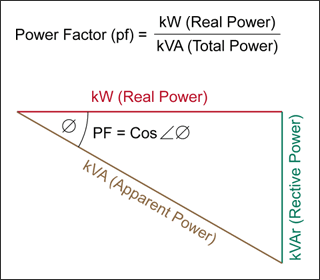
|
| Pressure Drop |
Amount of reduction in the pressure of a fluid
between the entering and leaving pressures. The pressure
drop in a chiller is dependant upon the tube ID of the tube
bundle and its length. Rough surfaces or objects that are in
the flow path can cause reduced pressure. |
| Pressure Gauge |
An instrument that measures pressure in psig,
psid or psia depending on the circumstances. |
| Primary Surface Area |
The area that contains the working heat
transfer fluid. Usually the tubes of a finned/tube heat
exchanger. |
| Pump |
A device used to circulate fluid from one
location to another. |
| Pump Curve |
The design capacity of a pump’s ability to
circulate fluid. |
| Pump Curve Calibration |
A flow test to determine the capacity of a
pump’s ability to circulate fluid. |
| Pressure |
The application of force to something by
something else in direct contact with it. |
| Pressure Drop |
The reduction in pressure between a fluid
entering and leaving a closed system. |
| Pretreatment |
The removal of oil and grease from new piping
and chillers to ensure maximum heat transfer. It should also
lay down a passivating film to prevent flash corrosion and
in some cases, white rust. |
| Pumpout System |
Pumpout systems consist of a storage tank
large enough to hold the chillers entire refrigerant charge
and a refrigerant pump/compressor to move the refrigerant
from the chiller to the pumpout tank and back again. It’s
primary purpose is for servicing the chiller. |
| Purge Unit |
Removes non-condensable gasses (air) from the
condenser barrel of the chiller. Required on all
low-pressure chillers only. |
| Quality |
The ratio of vapor mass to total mass of a
substance at the substance's saturation temperature and
pressure. |
| RAT |
Refrigerant Approach Temperature |
| Refrigerant |
The mechanism used by the chiller, which
performs heat transfer by converting from liquid to gas and
gas to liquid at various pressures and temperatures. Common
refrigerants used in commercial HVAC are R-11, R-12, R-22,
R-113, R-114, R-123, R-134a, R-500. |
| Refrigerant Analysis |
Laboratory analysis of a refrigerant sample to
determine contamination, typically oil or moisture. |
| Refrigeration Effect |
The amount of heat absorbed by the refrigerant
in the evaporator. |
| Restricted Flow |
Restricted flow is caused by an obstruction
(blockage) in system piping, chiller barrel or tower system. |
| Retrofit |
A retrofit is a modification to a chiller
system. For example, a new style compressor replacing an
older, less efficient style or to use a different
refrigerant to comply with new standards. The results can
affect energy efficiency. |
| Rotating Vane Anemometer |
Measures air velocity by use of a
rotating vane or fan. |
| Sacrificial Anode |
An anode that is made of a metal, typically
zinc or magnesium, that is lower on the galvanic chart so it
will be sacrificed to protect the mild steel tube sheet and
end bells in the chiller from galvanic corrosion. |
| Seal |
A seal is a tight and perfect closure (as
against the passage of gas or water) or a device to prevent
the passage or return of gas or air into a pipe or
container. |
| Secondary Surface Area |
The area that extends from the primary surface
area into the fluid being conditioned to enhance the heat
transfer. |
| Sensible Heat |
Heat that causes a change in the temperature
of an object or location. |
| Separation Gasket
|
Gasket used to separate a two or more pass
chiller between the inlet and discharge of the chiller. |
| Specific Heat |
The ratio of the quantity of heat required to
raise the temperature of one pound of a substance one degree
Fahrenheit to that required to raise the temperature of one
pound of water one degree, Btu/lb. For the metric system,
the unit of mass is kilogram and the temperature scale is
Celsius. |
| SRB |
Sulfate Reducing Bacteria. SRB can cause
significant localized pitting corrosion and severe damage in
the cooling tower system. |
| Strainer |
Used to remove foreign material from the water
flow. The mesh size determines the size of the
material/debris being removed. |
| Superheat Test |
A superheat test is the excess of the gas
suction temperature above the gas saturation temperature
The purpose of the superheat is to ensure that liquid
refrigerant does not enter the compressor.
Typically the standard is between 10 and 20°F. A high
superheat value is an indication of low refrigerant levels
and low superheat value is an indication of high refrigerant
levels especially when the compressor is operating at full
load.
|
| Suction Piping |
Refrigerant piping from the evaporator outlet
to the compressor suction inlet. |
| Temperature |
Degree of hotness or coldness of an object or
location measured on a definite scale. |
| Temperature Difference |
Degree of change between two temperatures. |
| Thermal Expansion |
Pressure and temperature regulation valve,
located in the liquid line, which is responsive to the
superheat of the vapor leaving the evaporator coil. |
| Thermal Conductivity |
Material property indicating how easily heat
travels through material. It depends on the physical
structure of matter at both the molecular and atomic level
as well as the state of matter, solid, liquid, or gas. |
| Thermometer |
Measures and evaluates temperature. |
| Transcritical Cooling |
Cooling by using the subcritical and
supercritical state of the refrigerant. The critical point
of a substance is the temperature and pressure where the
phase changes to what is called a "supercritical
fluid" which shows properties of both a liquid and a
vapor at the same time. Only a substance that has a critical
point near the ambient temperature can be used, making CO2
the refrigerant of choice for this process. |
| Total Surface Area |
The sum of the primary surface area and
secondary surface area. |
| Tube |
A pipe that water flows through to transfer
heat. |
| Tube Bundle |
A group of heat exchanging tubes. |
| Turbulent Flow |
Disturbed, chaotic flow of a fluid. The
velocity at a given point varies erratically in magnitude
and direction. |
| Two Phase Flow |
Change in phase (liquid to gas, gas to
liquid), due to changes in pressure or temperature, that
takes place while the fluid is circulating through the heat
exchanger. |
| Ultrasonic Flow Meter |
A device that is used to measure flow through
piping. |
| Vacuum |
A space partially exhausted by artificial
means (i.e., suction measured in inches of Hg in a low
pressure chiller). |
| Variable Frequency Drive
(VFD) |
A chiller with a variable frequency drive has
a controller that monitors the operating conditions and uses
a combination of inlet guide vanes and speed control. VFDs
act as a soft-starter. VFDs can offer significant energy
savings at part load conditions, but they typically do not
run as efficiently at full load when compared to constant
speed drives. |
| Vortex |
A mass of fluid (as a liquid) with a whirling
or circular motion that tends to form a cavity or vacuum in
the center of the circle and to draw toward this cavity or
vacuum bodies subject to its action. |
| Volts |
The practical meter-kilogram-second unit of
electrical potential difference and electromotive force
equal to the difference of potential between two points in a
conducting wire carrying a constant current of one ampere
when the power dissipated between these two points is equal
to one watt and equivalent to the potential difference
across a resistance of one ohm when one ampere is flowing
through it. Typical chiller voltages are 460, 480, 2400 or
4160. This information can be found in the chiller technical
documentation. |
| Water Treatment Program |
A water treatment program provides a biocide
program that minimizes microbiological growth along with
excellent scale/corrosion protection. |
| Wet Bulb |
The combination of outside air temperature and
relative humidity, affecting the ability of the tower to
evaporate water into the atmosphere. The higher the relative
humidity, the more difficult it is to evaporate additional
moisture. |
| Working Fluid |
The heat transfer fluid that changes the
temperature. |