|
|
 |
 |
 |
 |
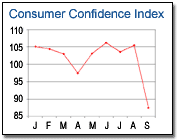
Consumer-Confidence Data UselessGraph to right is the January 2005 Consumer Confidence Index Chart from www.conference-board.org.
The two closely tracked indexes - from the University of Michigan and the Conference Board - may reveal the mood of Americans when they are surveyed, but they don't predict whether people will spend more or less, said Dean Croushore, an economics professor at the University of Richmond. "People may say they're dissatisfied with the economy, but then they go out and buy a car," Croushore said. Croushore said that when he began his study, he believed the confidence readings had value and that his analysis might show they were more insightful than perceived. "But the more investigation I did, trying all different types of models to make them work better, they kept getting worse and worse," he said. "I think the reason, a lot of times, is that consumer confidence just reflects the past. You lose your job, your confidence falls. There's not really anything new there. What we really want are indicators that look forward." Croushore, a former vice president at the Federal Reserve Bank of Philadelphia, said he spotted a fundamental flaw in older studies that found the indexes somewhat useful in predicting consumption. Those researchers had been comparing the consumer confidence indexes to widely used economic data that had been revised several times - sometimes drastically. It makes more sense, he said, to compare the indexes with "real-time" data - information available to consumers and researchers at the time the surveys were taken. When he crunched the numbers using the unrevised data, he found that in most cases, the indexes fell after recessions and rose after economic expansions - but not before those phases in the economic cycle. And the indexes provided little guidance on consumers' spending, Croushore said. For instance, Croushore said the two main indexes - the University of Michigan's Index of Consumer Sentiment and the Conference Board's Consumer Confidence Index - fell after the stock market crashed in 1987. But neither suggested that consumer spending would come back as strong as it did, he said. Croushore said the Michigan index performed worse in his unpublished study. In the late 1990s, for example, consumer spending increased, but the Michigan readings had showed confidence at a rather flat level while the Conference Board index had risen. Michigan's consumer surveys were created after World War II as a way of measuring consumers' optimism or pessimism. Each survey now includes about 50 questions that deal with everything from refrigerator purchases to inflation. Consumers are asked a number of follow-up questions, with a goal of understanding why they make certain financial decisions. The sentiment index is based on the answers to five questions in the survey, including consumers' views of their financial situations currently and in the future, their expectations about employment, and whether it's a good time to buy a major household appliance. A minimum of 500 telephone interviews are conducted each month, and a score is calculated based on the responses. The Conference Board's index, which dates to the 1960s, works in similar fashion. Its monthly survey is mailed to 5,000 U.S. households, with a response rate of 70 percent. Over time, both indexes have grown in importance, and they are now widely cited by economists, government officials, investors and the media. Both have the ability to send the stock and bond markets rising or falling, depending on whether the indexes met investors expectations. On Jan. 25, for example, Wall Street analysts said the release of the Conference Board's index helped propel the Dow Jones industrial average up nearly 93 points, its best day so far in 2005. Richard T. Curtin, director of the Michigan surveys, said it's more telling to look at consumers' responses to his survey's specific questions rather than the index itself. That's because over the decades, Americans' spending decisions have come to be based on an increasing number of factors, including expectations about interest rates and asset values, he said. "So the details are much more important than the overall number," Curtin said Robert H. McGuckin, economic research director for the Conference Board, said in an e-mail he hasn't had the chance to closely examine Croushore's study. But he said the group's researchers have used similar real-time forecasting tests in evaluating their Leading Economic Index, which includes consumer expectations. "We find the (Leading Economic Index) provides timely and accurate ex-ante information for predicting not only the business cycle turning points but also monthly changes in the economy," he wrote. McGuckin added that the group's consumer confidence survey "is not designed narrowly to focus just on forecasts of consumer expenditures." "We maintain that the Conference Board's Consumer Confidence Index provides a wide range of data that informs the business community, as well as the general public, about the health of the U.S. economy," he wrote. Latest Consumer Confidence Board's Index: The Conference Board's Consumer Confidence Index Edges Up in January
January 25, 2005
The Conference Board's Consumer Confidence Index, which had improved in December, edged up in January. The Index now stands at 103.4 (1985=100), up from 102.7 in December. The Present Situation Index increased to 110.9 from 105.7. The Expectations Index, however, declined to 98.4 from 100.7. The Consumer Confidence Survey is based on a representative sample of 5,000 U.S. households. The monthly survey is conducted for The Conference Board by TNS NFO. TNS NFO is one of the TNS group of companies (LSE: TNN). The cutoff date for January's preliminary results was January 19th. "Despite the slight retreat in expectations, consumers' short-term outlook remains favorable and suggests the economy will continue to expand throughout the first half of this year," says Lynn Franco, Director of The Conference Board's Consumer Research Center. "And, recent advances in the Present Situation Index, now at its highest level since May 2002, suggest consumers will not dramatically alter their spending in the months ahead." Consumers' overall assessment of current conditions improved in January. Those claiming business conditions are "good" increased to 26.0 percent from 24.4 percent. However, those claiming conditions are "bad" rose to 18.2 percent from 17.8 percent. The employment picture was also more favorable. Consumers saying jobs are "plentiful" increased to 20.7 percent from 19.4 percent, while those claiming jobs are "hard to get" fell to 24.7 percent from 26.4 percent. Consumers' short-term outlook, while not as optimistic as a month ago, remains positive. Those anticipating business conditions to improve in the next six months declined to 21.1 percent from 22.4 percent. Consumers expecting business conditions to worsen increased moderately to 8.0 percent from 7.7 percent. The outlook for the labor market remains virtually unchanged. Now, 16.3 percent of consumers, compared to 16.4 percent last month, expect more jobs to become available in the coming months. Those expecting fewer jobs edged up to 15.5 percent from 15.3 percent. Consumers expecting their incomes to improve in the months ahead edged down to 18.0 percent from 21.0 percent last month. Source: January 2005 Consumer Confidence Index, The Conference Board. The next release is scheduled for February 22, Tuesday at 10 A.M. ET.
On the Net: http://www.conferenceboard.org/ http://www.sca.isr.umich.edu/ |
| | | |