Ten minutes of X-rays tell of a supernova in the making
Check out our story on: A supernova watched from start to finish at the bottom of this story...
GDO Report
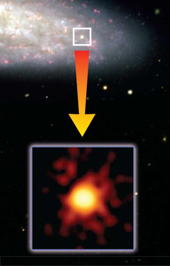
SPACE - The galaxy NGC 2770 appears to be have been a pretty exciting place, at least from a distance. Researchers were using NASA's orbiting Swift observatory to look at the remains of a supernova that went off there last year, when a second one went off in the same galaxy. Thanks to that bit of serendipity, we now have the best information yet on what happens when the energy produced by the collapse of star's core hits the surface of the star.
The X-rays themselves lasted for roughly 10 minutes, during which time they carried about 1039 joules away from the dying star. Follow up observations using other telescopes confirmed that the Swift had indeed observed a supernova, one that was still lighting up at a variety of wavelengths. An analysis of these observations appear in today's issue of Nature, and they suggest that the authors were lucky enough to begin their observations within nine seconds of when the X-ray burst started.
|
A Super Nova from Start to Finish....
 |
SPACE - Nearby supernovae are rare events indeed, so the one termed SN 2006aj might have been expected to make a big splash.
But the splash from this one was big indeed: four papers and a perspective in Nature (conveniently linked from a single editor's summary) and coverage on CNN. |
The reason for the attention all comes down to NASA's Swift observatory working as it was designed: detecting high energy gamma-rays, and rapidly spinning to observe them. In this case, the trigger was a gamma-ray burst (named GRB060218) that signaled the star's impending collapse, and continued observations revealed a later X-ray flash, termed XRF060218. Ground based observations eventually revealed the broad-spectrum output that signaled the explosion of a star.
The analysis confirms that SN 2006aj/GRB060218/XRF060218 are all one and the same, and thus these observations provide the first case where a gamma-ray burst has been definitively associated with a supernova, as well as the first time that a supernova has been imaged at the moment when the shock wave of the explosion reaches the surface of the star, bringing its power into view in the visible spectrum.
The star in question appears to have been about 40 times the mass of our sun, and belonged to a class called a Wolf-Rayet. These stars have ejected most of their lighter material, and are composed primarily of elements such as carbon and oxygen. This unusual composition and lower mass make this different from the source of the more violent Type-II supernova, and places it in a class called Type-Ic. The gamma-ray burst apparently signaled the collapse of the star's core, while the X-rays that followed apparently had two sources. One was the motion of the shockwave itself, moving at about 90 percent of the speed of light (the authors termed this "mildly relativistic"). The second appears to be generated by jets of matter being spun off by the neutron star at nearly the speed of light; this later, relativistic source kept pumping out X-rays for weeks after the shock wave had blown out the star. The visible light from the explosion also extended longer than might be expected, as the fusion reactions during stellar collapse produced a nickel isotope with a short half life. Its rapid decay started re-heating the remains after two days.
Putting all of this together, it appears that the primary thing that distinguishes the X-ray production by this Type-Ic explosion from Type-II supernovae and their gamma-ray output is simply mass. The relatively low mass of this star simply resulted in a lower energy explosion that was otherwise very similar to that produced by models of gamma-ray bursts. To a biologist like me, this suggests that current models of these explosions are on the right track, as they can explain a broad range of conditions.
//////////////////////////////////////////////////////////////////////////////////
|
The big questions is what the X-rays that signaled the supernova represent. The authors argue that they were the product of what's termed "shock break out," the moment when the energy from the collapse of the star's core first reaches the actual surface of the star. This rockets the star's remaining matter outwards and allows a flood of radiation to escape. That matter then collides with the particles in the solar wind, which produced some of the Infrared and X-ray emissions seen in the follow-up observations. Even more energy comes out of the remains as the unstable elements created by the explosion start undergoing radioactive decay.
Based on the observations, the authors argue that the best fit for the data is a Type-Ibc supernova, caused by the death of a Wolf-Rayet star. These stars often shed a lot of their mass prior to exploding, and this one (now termed SN 2007uy) was no exception—there was actually a lot more matter present outside the stellar remains than models had predicted. In this sense, it was similar to an earlier supernova that was tracked as it exploded based on observations of gamma ray bursts.
The authors argue that X-ray outbursts will be a necessary part of any core-collapse supernova, and suggest that several hundred of these could be detected every year by a satellite with Swift's sensitivity (provided it was looking in the right place). They argue that wide-field X-ray survey satellites could spot many more than Swift does, and could provide helpful information to complement the observation of these events using neutrino and gravity wave detectors.
<--> |


