RealNet News - Online Edition
<% Else %> <% End If %>
<% If Request.QueryString("printerFriendly")= "true" Then %>
RealNet News - Online Edition<% Else %>
<% End If %>
|
 |
 |
 |
 |
2006 Online advertising revenues threaten to exceed the $20 billion level<%If Request.QueryString("printerFriendly")<>"true" Then %> <% End If %>
<% If Request.QueryString("printerFriendly")<>"true" Then %>
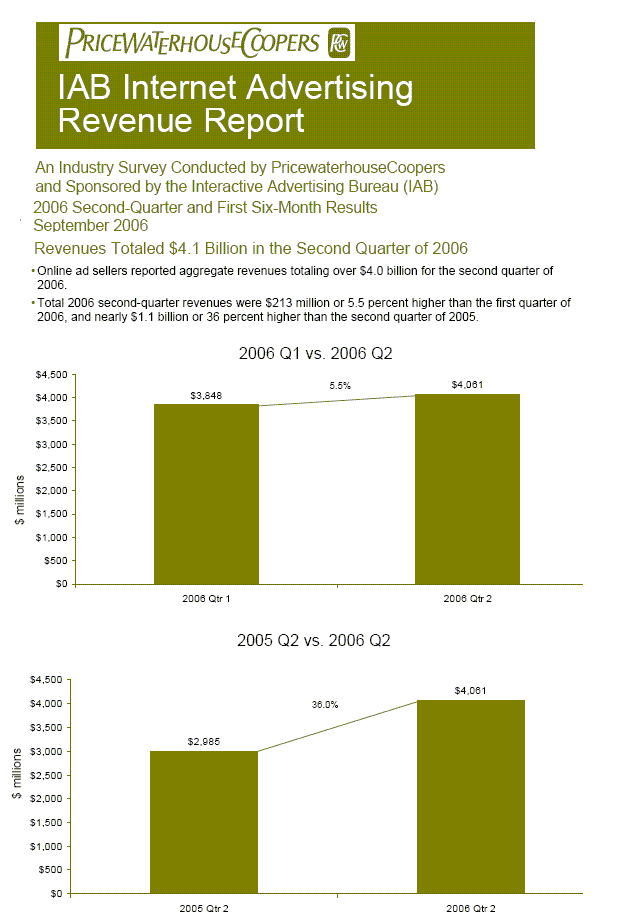
IAB Internet Advertising Revenue Report An Industry Survey Conducted by PricewaterhouseCoopers and Sponsored by the Interactive Advertising Bureau (IAB) 2006 Second-Quarter and First Six-Month Results September 2006 pwc Background About the IAB Internet Advertising Revenue Report Conducted by the New Media Group of PricewaterhouseCoopers LLP on an ongoing basis, with results released quarterly, the “Internet Advertising Revenue Report” was initiated by the Interactive Advertising Bureau (IAB) in 1996. This report aggregates data and information reported directly to PricewaterhouseCoopers LLP by companies representing thousands of Web sites, in addition to other online ad selling companies. The results reported are considered the most accurate measurement of Internet/online advertising revenues since the data is compiled directly from information supplied by companies selling advertising online. All-inclusive, the report includes data reflecting online advertising revenues from Web sites, commercial online services, e-mail providers, as well as other companies selling online advertising. The report is conducted independently by PricewaterhouseCoopers LLP on behalf of the IAB. PwC does not audit the information and provides no opinion or other form of assurance with respect to the information. Only aggregate results are published and individual company information is held in strict confidence with PricewaterhouseCoopers LLP. Further details regarding scope and methodology are provided in the appendix to this report. PricewaterhouseCoopers LLP 3 • Revenues Continue to Post Record Results – Internet advertising revenue in the U.S. totaled$4.06 billion in the second quarter of 2006, marking the seventh quarterly revenue increase since the fourth quarter of 2003. Total revenues for the 2006 second quarter increased 5.5 percent from the 2006 first-quarter total of $3.85 billion, and 36 percent from the 2005 second-quarter total of $2.99 billion. Year-to-date Internet advertising revenues through June 2006 totaled $7.9 billion, up nearly 37 percent versus the same six-month period in 2005. "Interactive delivers an arsenal of options for advertisers no matter their marketing and business objectives. From search, broadband, lead generation, behavioral targeting, consumer generated content and new emerging platforms like mobile and iPTV, Interactive continues to solidify its position as a mainstream medium. This latest report is a clear indication that Interactive is of increased importance to marketers today to engage their consumers and drive sales." – Greg Stuart, President and CEO, IAB • Consumer Advertisers Lead Spending – Consumer-related advertisers accounted for thelargest category of revenues at 49 percent of 2006 second-quarter revenues, down from 51 percent from the same period in 2005. Financial Services, the second-largest category, accounted for 16 percent, followed by Computing advertisers at 10 percent. Within the Consumer category the biggest sub-categories are Retail (47 percent of 2006 second-quarter consumer revenue category), Automotive (21 percent), Leisure (14 percent) and Entertainment (8 percent). "The latest results reaffirm the Internet's growing importance for marketers to integrate online advertising into their overall media plans. While search advertising remains the largest format in terms of revenues, we expect to see new formats like video ads to continue to emerge as advertisers seek to leverage the branding opportunities afforded by the growing installed base of broadband users." – David Silverman, Partner, PricewaterhouseCoopers LLP • Search Continues to Lead, Followed by Display, Classifieds and Referrals – Search revenueaccounted for 40 percent of 2006 second-quarter revenues, consistent with the same period in 2005. Display advertising, Classifieds, and Referrals all increased compared to last year accounting for 21 percent, 20 percent, and 7 percent of 2006 second-quarter revenues respectively. "Internet advertising continues to reach new milestones, exceeding $4 billion in quarterly revenues for the first time, and on pace for another record year of revenues. With the seventh consecutive quarter of growth behind us we are confident that the Internet will continue to reconcile the imbalances between its share of media consumption versus its relative share of total advertising spend." Executive Summary IAB Internet Advertising Revenue Report 2006 Second-Quarter and First Six-Month Highlights Internet advertising revenues (“revenues”) in the United States totaled $7.9 billion for the first six months of 2006, with Q1 accounting for $3.85 billion and Q2 totaling $4.06 billion. Internet advertising revenues for the first six months of 2006 increased nearly 37 percent from the same period in 2005. Key trends underlying 2006 year-to-date results: Detailed Findings Revenues Totaled $4.1 Billion in the Second Quarter of 2006 • Online ad sellers reported aggregate revenues totaling over $4.0 billion for the second quarter of 2006.Search, Display and Classifieds Lead Ad Formats • Search remains the largest revenue format, accounting for 40 percent of 2006 Q2 revenues, consistentwith the 40 percent reported for the same period in 2005. Search advertising revenues totaled $1.6 billion in the second quarter of 2006, up 36 percent from the second quarter of 2005, when Search revenues totaled $1.2 billion. • Display-related advertising accounted for $1.3 billion or 31 percent of total revenues during the secondquarter of 2006, compared to the $1.0 billion (34 percent of total) reported in the second quarter of 2005. Display-related advertising includes Display ads (21% of 2006 Q2 revenues), Rich Media (6%), and Sponsorship (4%). Display-related advertising revenues totaled $2.4 billion or 31 percent for the first six months of 2006 revenues, compared to $2.0 billion (34 percent of total) reported for the same period in 2005. • Classifieds revenues accounted for 20 percent of 2006 second-quarter revenues or $812 million, upslightly from the 18 percent reported in the second quarter of 2005. • Lead Generation revenues accounted for 7 percent of the 2006 second-quarter revenues or $284million, up slightly from the 6 percent reported in the second quarter of 2005. % in 2006.
Appendix Definitions of Leading Industry Categories The industry categories used in the IAB Internet Advertising Revenue Report were sourced from the Northern American Standard Industrial Classification (SIC) Manual.* Consumer-Related – includes industry categories classified as consumer-related, including automotive,mail order/catalog, travel/hotel/airlines, amusement & recreation, apparel, drug stores, home furnishings/textiles, retail stores, cosmetics, jewelry, restaurants/fast food, household products, tobacco, toys, pet food/supplies and appliances. Computing Products – includes hardware (computers, computer storage devices, and computerperipheral equipment), prepackaged software (operating, utility and applications programs), local area network systems and network systems integration, computer processing and data preparation, and data processing services. Financial Services – includes commercial banks, credit agencies, personal credit institutions,consumer finance companies, loan companies, business credit institutions, and credit card agencies. Also includes companies engaged in the underwriting, purchase, sale or brokerage of securities and other financial contracts. Telecommunications – includes point-to-point communications services, including telephone voice anddata communications, two-way mobile/cellular communications services, and other non-vocal message communications services (e.g., cablegram, electronic mail and facsimile). Media – includes establishments primarily engaged in radio and television broadcasting (network andstation) including commercial, religious, educational, and other radio or television stations. Includes multi-channel video providers on a subscription fee basis (e.g., cable television, wireless cable television, and direct broadcast satellite services). Also includes establishments primarily engaged in publishing newspapers, periodicals and books. * Survey participants reported results based on the 37 industry categories listed on page 13, which were used specifically for the IAB Internet Advertising Revenue Report. This is consistent with other relevant industry categorization sources that measure advertising spending by industry. For purposes of this report, PricewaterhouseCoopers classified a number of individual categories under “Consumer Related.” PricewaterhouseCoopers LLP 12 Definitions of Advertising Formats Display Advertising – advertiser pays an Internet company for space to display a static or hyper-linked banner or logo onone or more of the Internet company’s pages. Sponsorship – represents custom content and/or experiences created for an advertiser which may or may not include adunties (i.e., display advertising, brand logos, advertorial and pre-roll video). Sponsorships fall into several categories: • Spotlights are custom built pages incorporating an advertiser’s brand and housing a collection of content usuallyaround a theme; • Advergaming can range from an advertiser buying all the ad units around a game or a “sponsored by” link tocreating a custom branded game experience; • Content & Section Sponsorship is when an advertiser exclusively sponsors a particular section of the site or email(usually existing content) reskinned with the advertiser’s branding; • Sweepstakes & Contests can range from branded sweepstakes on the site to a full-fledge branded contest withsubmissions and judging other commercial e-mail communications. Includes all types of electronic mail (e.g., basic text or HTML-enabled). Search – fees advertisers pay Internet companies to list and/or link their company site domain name to a specific searchword or phrase (includes paid search revenues). Search categories include: • Paid listings – text links appear at the top or side of search results for specific keywords. The more a marketer pays,the higher the position it gets. Marketers only pay when a user clicks on the text link. • Contextual search – text links appear in an article based on the context of the content, instead of a user-submittedkeyword. Payment only occurs when the link is clicked. • Paid inclusion – guarantees that a marketer’s URL is indexed by a search engine. The listing is determined by theengine's search algorithms. • Site optimization – modifies a site to make it easier for search engines to automatically index the site and hopefullyresult in better placement in results. Referrals / Lead Generation – fees advertisers pay to Internet advertising companies that refer qualified purchaseinquiries (e.g., auto dealers which pay a fee in exchange for receiving a qualified purchase inquiry online) or provide consumer information (demographic, contact, behavioral) where the consumer opts into being contacted by a marketer (email, postal, telephone, fax). These processes are priced on a performance basis (e.g., cost-per-action, -lead or - inquiry), and can include user applications (e.g., for a credit card), surveys, contests (e.g., sweepstakes) or registrations. Classifieds and auctions – fees advertisers pay Internet companies to list specific products or services (e.g., online jobboards and employment listings, real estate listings, automotive listings, auction-based listings, yellow pages). Rich media – advertisements that incorporate animation, sound, and/or interactivity in any format. It can be used eithersingularly or in combination with the following technologies: sound, Flash, and with programming languages such as Java, JavaScript, and DHTML. It is deployed via standard Web and wireless applications including e-mail, static (e.g. html) and dynamic (e.g. asp) Web pages, and may appear in ad formats such as banners, buttons, and interstitials. Interstitials are included in the rich media category and represent full- or partial-page text and image server-push advertisements which appear in the transition between two pages of content. Forms of interstitials can include splash screens, page takeovers and pop-up windows. Broadband Video Commercials –TV-like advertisements that may appear as in-page video commercials or before,during, and/or after a variety of content in a player environment including but not limited to, streaming video, animation, gaming, and music video content. This definition includes broadband video commercials that appear in live, archived, and downloadable streaming content. Slotting fees – fees charged to advertisers by Internet companies to secure premium positioning of an advertisement ontheir site, category exclusivity or similar preference positioning (similar to slotting allowances charged by retailers). Survey Scope The Interactive Advertising Bureau (IAB) retained PricewaterhouseCoopers to establish a comprehensive standard for measuring the growth of Internet/online advertising revenues .• The IAB Internet Advertising Revenue Report is an ongoing IAB mission to provide an accuratebarometer of Internet advertising growth. • To achieve differentiation from existing estimates and accomplish industry-wide acceptance, keyaspects of the survey include: - Obtaining historical data directly from companies generating Internet/online advertising revenues;- Making the survey as inclusive as possible, encompassing all forms of Internet/online advertising,including Web sites, consumer online services and e-mail providers; and - Ensuring and maintaining a confidential process, only releasing aggregate data.Methodology • PricewaterhouseCoopers:- Compiles a database of industry participants selling Internet/online advertising revenues.- Conducts a quantitative mailing survey with leading industry players, including Web publishers,commercial online service providers, e-mail providers and other online media companies. - Requests and compiles several specific data items, including monthly gross commissionableadvertising revenue by industry category and transaction. - Identifies non-participating companies and applies a conservative revenue estimate based onavailable public sources. - Analyzes the findings, identifies and reports key trends.- The 2001 and 2000 full-year revenue data were adjusted to reflect revenue restatements reported inpublic filings by several individual companies. Those reported restatements totaled $77 million in 2001 and $138 million in 2000. Historical industry revenue figures are now adjusted to $7.134 billion in 2001 and $8.087 billion in 2000. Survey Industry Categories
PricewaterhouseCoopers New Media Group PricewaterhouseCoopers ( www.pwc.com) provides industry-focused assurance, tax and advisory servicesfor public and private clients. More than 120,000 people in 144 countries connect their thinking, experience and solutions to build public trust and enhance value for clients and their stakeholders. Unless otherwise indicated, "PricewaterhouseCoopers" refers to PricewaterhouseCoopers LLP, a Delaware limited liability partnership. PricewaterhouseCoopers LLP is a member firm of PricewaterhouseCoopers International Limited. PricewaterhouseCoopers’ New Media Group was the first practice of its kind at a Big Four firm. Currently located in New York, Los Angeles, Boston, Seattle and the Bay Area, our New Media Group includes accounting, tax and consulting professionals who have broad and deep experience in the three areas that converge to form new media: advanced telecommunications, enabling software and content development/distribution. Our services include: • Business assurance services • Web audience measurement and advertising delivery auditing and advisory • IAB Measurement Certification Compliance auditing • Privacy policy structuring, attestation and compliance advisory • Mergers & Acquisition assistance • Tax planning and compliance • Capital sourcing and IPO assistance PricewaterhouseCoopers LLP is a licensed CPA WebTrust auditor, a designated TRUSTe auditor, and the leading service provider in the area of Web Advertising Delivery Auditing. <--> |
| | | |